Saturday, 4 February 2012

4 reasons why you should put cardio into your routine

I apologise for the extra long time between posts. I've been working on a huge project that should help bodybuilders and fitness fanatics of all levels of experience reach their goals and potential. Stay tuned :)

    When the average person thinks of the word "cardio", the first image that comes to mind is that of the bane of all newcomers to the gym - the treadmill! Hours spent huffing and puffing, sweating away on this infernal machine, that is more like a torture device, than a tool to improve fitness. It need not be this way though, cardio can be extremely useful in bodybuilding, for several reasons that you may not have even considered.

Wednesday, 11 January 2012

Newbie Masterclass: Why Newbies should pick Starting Strength over a body part workout split


    I said I was going to write on macro-nutrients, but I thought you guys may be more interested on the training aspect of things, so I'll keep that one for a little later :).


     Just got your gym membership. Went to the local supplement store, got yourself some protein powder and a brand new t-back singlet. You're pumped up and ready to smash out your first workout. Time to slap on some mass! Your best mate gave you a workout split and tells you "it's top notch, I got it from this website brah, it's legit". Bicep Curls and Cable-cross overs, ad infinitum. You're all ready to go, right?


How to get a big chest: Cable Cross-overs x 100
(not really)

                                                          WRONG! 


    This is a mistake that a lot of beginner lifters fall into - getting caught up in using all the shiny machines like the pec deck, and isolation exercises like Dumbbell Tricep Extensions, all the while forgetting the bread and butter movements of bodybuilding - the compounds!


   The compound exercises - the big lifts like the squat and deadlift, and upper body lifts like the overhead press, bench and barbell row - are the cornerstones of bodybuilding, and the exercises that have stood the test of time as bodybuilding staples.


Activate most of the muscle groups in your body
with the deadlift.


    Why are these exercises so good? Why not pick a lat pull-down over a barbell row? The main premise behind this training philosophy, is that the compound movements will always activate more muscles than a simple isolation movement. A compound movement like the back squat will not only hit the quadriceps, but will also activate the hamstrings, glutes, hip adductors and the core.


   This large activation of muscle groups makes the compounds overall superior exercises vs. isolation. Isolation exercises do have their place, though compounds will always be always be able to stress more muscles, and to a higher degree, which results in better overall physique development. The only way to build a truly complete physique, is to have compound movements at the forefront of your program. 


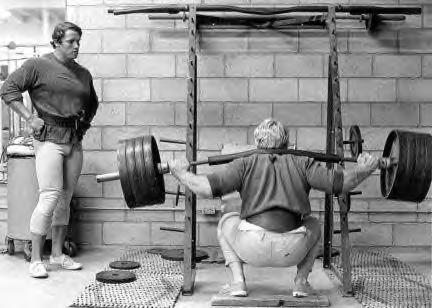
Tom Platz - King of the squat. Arguably the best overall
 leg development, even by today's standards.


    Isolation exercises should be used as their name suggests - to isolate and further develop muscles that aren't targeted fully by compounds. They serve simply to develop and stress the muscles in ways that compounds cannot - they should be used to supplement your routine on top of compounds, they shouldn't be the main focus of it.


    Some of you are probably reading this and thinking "Well, ok, that makes sense, but what does that have to do with me? I just want to start lifting weights". Well, this is where it gets interesting for beginners. One of the fundamental principles behind bodybuilding, as well as many other forms of physical training, is that of progressive overload.
Flex Wheeler- A product of 
progressive overload.


    Progressive overload is the principle that in order to increase your strength (and mass), you must place the muscles under increasing stress, or in other words, overload them. There are a few ways to overload a muscle:

  • Increased volume: increasing the amount of reps per set, or increasing the amount of sets (thus increasing reps in a round-about sort of way).
  • Increased intensity: Making each individual rep harder, slower negative rep, more explosive positive rep. Shortening rest times between sets.
  • Increased frequency: Body parts do not require a full 7 days to recover. You can hit a muscle 2 (or some muscles even 3 times a week), and yield improved gains.

    For beginners, overloading is easy. Since most beginners will have almost no physical training base, they can gain strength and mass doing just about anything in the gym. Over time though, strength and mass gains will eventually slow down, and newbies will have to start overcoming plateaus with increasing muscular and nervous system stress.


Mike Mentzer, the King of intensity.


    These easily achieved gains are commonly referred to as "newbie gains", and are generally the easiest strength and mass gains a lifter will ever make in their career. This period gives beginners an opportunity to build a strength base, that will serve them well into their 2nd and 3rd years of training and beyond. 

   The most efficient way to build overall strength when first stepping into a gym, is to start off with a program such as Starting Strength, which incorporates all of the compound movements into one program (as well as one olympic lift). This will give beginners a great overall strength base within the first couple of months of lifting, as well as improving the neural connection between mind and muscle, which is vital to higher level strength and mass gains. Beginners will also see and increase in core stability, which will also serve them well when trying to progress lifts later on along the line.


 Once a good level strength is attained (between 2-5 months of training), beginners will be able to move onto progress-based routines such as Madcow 5x5, which is a program fundamentally based upon the principle of progressive overload, and looks to push progression from week to week through slowly increasing the weight.

Power Cleans - fire up the nervous system, and activate
most of the muscles in your body.


    Squeezing every last bit that you can out of your newbie gains will serve you well later on in your lifting career. Having bigger lifts will have great carry over to other isolation and assistance exercises. For example, if you are squatting 315lb for reps, this will have a level of carry-over to your leg press which may be around 7-8 plates a side. Having greater strength on assistance exercises will give you more flexibility when selecting set/rep structure (e.g, start off with 4 plates, then 5, 6 etc - ascending weight/pyramiding). If you were only to squat 200lb, your leg press may only be 4 plates, which does not give a hell of a lot of flexibility in terms of changing your training style, and you will be more or less restricted to uniform weight.


    In conclusion, if you want to get big, and build the physique that you dream of, then you must not neglect the compounds, they are any lifters best friend, and the fastest way to get to beast mode.

Thursday, 5 January 2012

6 Common Dieting Mistakes of Beginner Bodybuilders - Part 2

4. Inconsistency 
    Probably the most common mistake of all beginners. The only way to truly reap the benefits of your diet is to stick to it. Deviating from your diet, and sneaking in a snack here and there all adds up. As the great Greek philosopher Aristotle once said, "We are what we repeatedly do. Excellence, then, is not an act, but a habit".


Dieting can be hard, but selecting a variety of
whole foods for your diet can make the task a lot easier

    The best way to stay consistent is to have two structured diets, with all your calories and macro-nutrients counted up, and simply eat according to one of the two diets, and switch as you feel to maintain variety. Also, not relying on 1-2 main sources of protein and carbs, but rather diversifying your food choices, will also aid in helping you stick to your diet in the long term.

5. Crash Dieting


    More of a problem during the cutting phase than the bulking phase, is when people try to diet down too fast, and launch head first into a diet, in order to get as lean or as big as possible, in the shortest amount of time. While you may achieve your goal of leanness or mass, odds are you will sacrifice a lot of muscle mass or add a lot of unnecessary body fat in order to reach that point.

    Dieting to add muscle or dieting to cut fat, are both gradual processes which require not only consistency, but patience. You must be patient in your approach, and not attempt to add muscle or cut fat too fast. The result will either be you gaining excessive amounts of bodyfat (useless to bodybuilding) or you sacrificing your hard earned muscle gains.


All good things take time.
   A good way to overcome this is to track your progress with a log and progress pics. This way, you can see how you are progressing in muscle mass or leanness, and not be tempted to go on the freight train equivalent of a diet, as both of these tools easily illustrate your progression over time.


6. Over-reliance on supplements


    Up there with crash dieting as one of the more common mistakes, over-reliance on supplements is a trap that many beginner bodybuilders fall into.


Add 410% more muscle mass than
regular creatine monohydrate in 2 weeks!
(not at all srs)

    Supplements are exactly that - supplements. They are there to supplement your diet, when your diet has already done all the work it can do. Supplements will convey little to no benefit if your diet is not on point. Furthermore, most supplements will only garner a few percentage point increase in results, at best.


Supplements that are proven to work (and that you should use):
  • Creatine -aids in adding muscle by supporting the ATP energy system, which in turn allows for increased explosive movement within training.
  • Whey Protein - helps to boost your protein intake. It is not some mythical powder that will instantly grant you muscle mass. Whey protein is derived from whey, which is a by-product of the production of cheese, which is in turn derived from cow's milk. Basically, the protein within whey protein, is exactly the same as one of the proteins in regular cow's milk (the other being casein). The only difference is, is that whey protein is not a whole food (it is just the protein, amino acids and trace micronutrients, fat and carbs only) and milk is a whole food (more or less unprocessed, outside of homogenisation and pasteurisation)
  • Fish oil - A supplement with a myriad of health applications, inside and outside of bodybuilding. Proven health benefits in supporting the cardiovascular system, leanness, as well as being an anti-inflammatory agent.
  • Multivitamin - Bodybuilding diets are generally lacking in a range of vegetables, and thus lots of the nutrients associated with them. A multivitamin is useful in aiding in filling any potential micro-nutrient gaps that your diet may have.

Supplements that sorta kinda work, but aren't necessary:
  • Caffeine Anhydrous - mild stimulating, thermogenic and hunger suppressing effects.
  • Green Tea extract - mild stimulating, thermogenic and hunger suppressing effects.
  • BCAAs - completely unnecessary during bulking phases, as complete/animal proteins will contain sufficient BCAAs, but has some application during strict cutting dieting periods.
  • 1,3 Dimethylamylamine - it's a stimulant, and it stimulates, but is not necessary.

Supplements that have benefits that are negligible at best, or probably don't work at all, completely unnecessary:
  • Just about everything else on the market.

    Supplements (whey protein in particular) should not be your main focus in dieting. You should not use a whey protein powder as a caloric crutch, because you can't be bothered preparing a chicken breast or some eggs. All supplements do is give you a slight edge in results, whole foods and a good diet will ALWAYS be superior. Always remember that.


Thanks for reading! Tune in next time when I cover the roles and function of the 3 main macronutrients - fats, proteins and carbohydrates.

6 Common Dieting Mistakes of Beginner Bodybuilders - Part 1

Dieting is often one of the more daunting aspects of bodybuilding, and the mechanics behind it are frequently misunderstood, even by experienced lifters. In this post, I'll cover some of the most common, yet easily rectified mistakes that many beginner bodybuilders make.


1. Under-eating 


A bodybuilding diet is vastly different to that of a diet of a regular, everyday person. A bodybuilder must fuel the body with enough macro-nutrients (fat, protein, carbohydrates) in order to not only facilitate repair of the muscle and recovery, but also have a positive energy balance in order to promote and facilitate growth, as well as replenish energy reserves.

   What this essentially means is (generally speaking), is that if you want to increase muscle mass, you must be consuming more calories than you burn. In some cases, you can add muscle (and lose fat) while eating at or under your caloric maintenance, though this is a more advanced dieting concept known as body recomposition or recomping, for short, which I may cover in the coming weeks.

   The amount of energy you expend, as well as your calorie maintenance (the amount of calories you need to eat to maintain your current weight) are dependent upon genetics, body composition (fat/muscle) and activity levels, and other factors such as gender and hormonal levels/fluctuations. How fast is your metabolism? How does your body retain bodily fat? How much muscle, and how much fat do you carry? How physically active are you during the day? The factors of gender and hormonal levels/fluctuations are more general - women will naturally almost always carry more fat than men, due to lower levels of testosterone (and thus muscle mass), as well as the the monthly cyclic hormonal fluctuations (which can also lead to mild water bloating).

One protein shake a day on top of your normal diet, isn't going to do it.
(No, I am not sponsored by Muscle Milk)
    All these factors make it exceedingly hard to determine a magical calorie level that you can eat at, which will allow you to maintain your weight forever (I'd go as far as to say that it's impossible). Despite this, there are ways around this . Freedieting.com offers a calorie calculator, which can give you a good idea of a calorie starting point for your diet.  A "bulk" - a dieting phase where you eat over maintenance, with the goal of adding muscle, and staying relatively lean - generally requires around a 300-800 calorie surplus, on top of your maintenance calories. Assuming your training is up to scratch, if you are not gaining weight consistently, you may have to trial-and-error your calorie level, and slowly push your calorie level up, until you can find a level which you can gain at.


   If you are not recovering properly, adding muscle or gaining too much fat, you may have to look at the proportions in which you are eating each macro-nutrient, which leads me to the next mistake made by newbies...


2. Over-eating 

    Though bodybuilders want to consume a host of wholesome, nutrient-rich foods to add muscle, the amount of food that you eat, and the proportions of the macro-nutrients must be calculated with a purpose in mind. Simply gorging yourself with everything in sight containing the slightest bit of protein will not work. You may add plenty of muscle, but it is likely that you will add a TON of bodyfat if you do not execute a proper dieting protocol.


When bulking goes wrong. Don't be this guy.

    Bodybuilders do not want to simply add muscle as fast as possible. They also want to remain as lean as possible, while gaining as much muscle as possible. Why? Well, the flip side to the bulking phase, is the cutting phase. In this period of dieting, bodybuilders seek to cut down bodyfat, in order to reveal the muscle mass they built up during the bulk. Now, if you are carrying more bodyfat, this would take longer right? Correct. Not only that, but it is inevitable that bodybuilders will lose some muscle mass during their cuts. If they can reduce the time they are cutting, they can in turn then increase the amount of muscle they retain through out their cutting phases of dieting.


You don't look like this by gorging yourself
during bulking periods.
    The typical macro-nutrient split starting point of bodybuilders is 40/40/20. That is, 40% protein, 40% carbohydrates and 20% fat, as percentages of total calories. Though since everyone is different, as you get more experienced, you will want to tweak the macro-nutrient amounts. Some may prefer higher fat levels, and may deem the 40% protein as excessive. Others may prefer to maintain the carb level in order to keep their energy reserves replenished. As you become more experienced in dieting, these choices will come naturally to you.


3. Mis-eating


    To perform at your best in and out of the gym, you must assure that the foods you are eating are wholesome, and relatively un-processed. You will want your protein to come from whole animal meats/products such as beef steaks, kangaroo mince, tuna, milk, eggs and tuna. You will want your carbohydrates to come from cereal grains such as oats, brown rice, white rice, starchy fruit/vegetables such as sweet potato and bananas, and wholegrain products such as wholegrain pasta and bread. Lastly, your fat should be derived mainly from animal fats within meats, as well as high quality, unrefined and (relatively) unprocessed vegetable fats such as olive oil.


Oh so tempting, but a good steak and some brown rice
will give you more nutritional bang for your buck.


    What's the reasoning behind this? Why not just eat McDonalds, KFC and Pizza to fulfil your macro-nutrient targets? Well, while your body requires macro-nutrients such as protein, fat and carbohydrates to function to it's fullest, it also requires another type of nutrient - micro-nutrients. Micro-nutrients are not required in as large amounts as macro-nutrients, but still play a highly important role in muscle building and muscle retention, as well as leanness and overall well-being.

   Highly processed foods such as those provided at fast food outlets, are so highly processed that they have been stripped of almost all of their micro-nutrients, which can aid in supporting a whole array of functions within the body.

   Micro-nutrients include the natural vitamins and minerals found in food, such as Zinc, Iron, Magnesium, Vitamin A, as well as lesser known ones such as creatine, which occurs naturally within some foods. Micro-nutrients such as zinc and iron aid in regulating certain bodily functions, whereas creatine aids in muscular maintenance and hypertrophy.


   However minor each micro-nutrient may seem, each has a role in maintaining normal bodily function, which is not only important for bodybuilding, but overall health. Other micro-nutrients will additionally aid muscle maintenance, and leanness, which have obvious benefits within bodybuilding.